
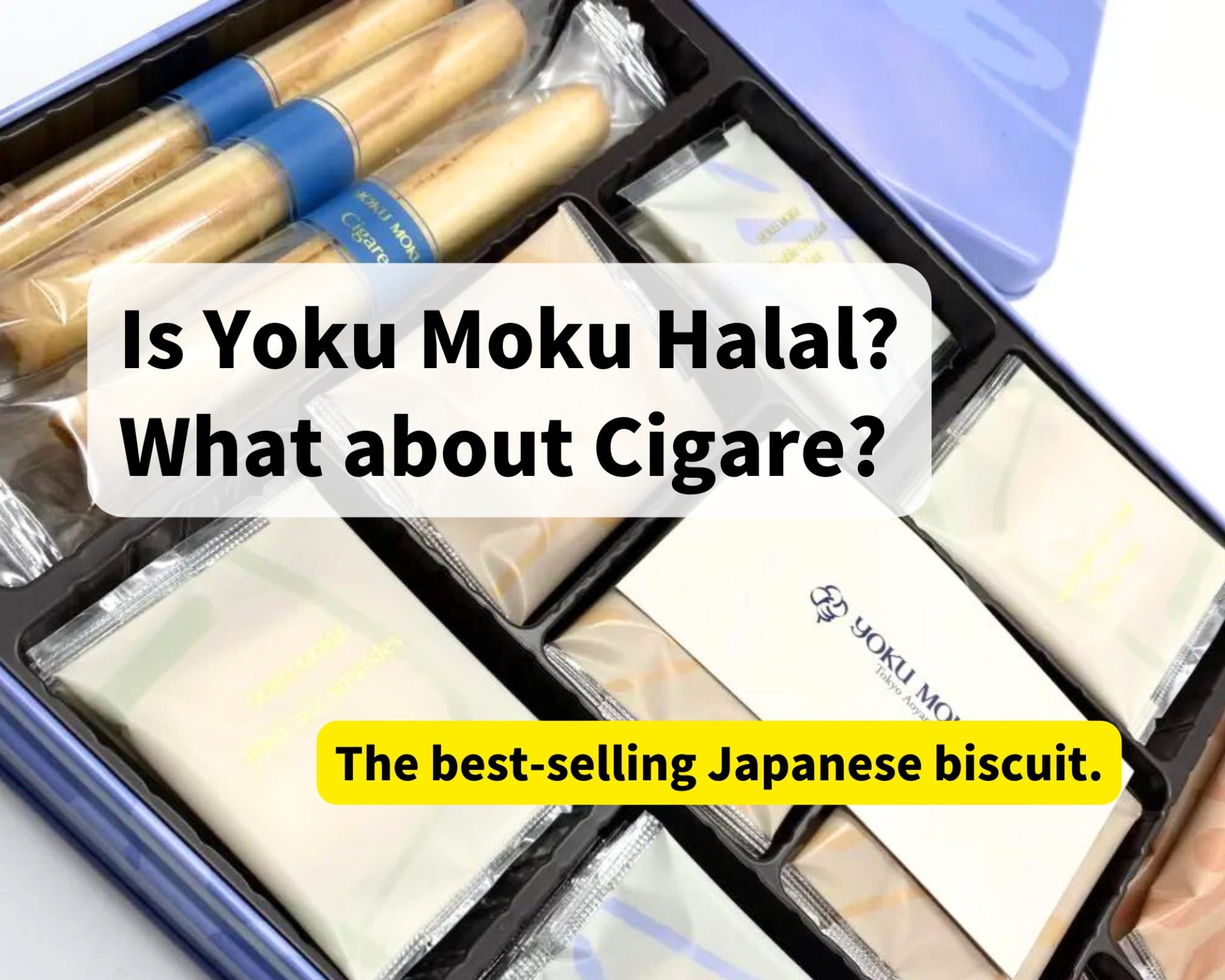
Japanese confectionery appreciated in Middle East.

Yoku Moku is one of Japan’s most elegant confectionery brands, widely appreciated in the Middle East. In 2011, the company opened its first shop in Dubai, and since then it has expanded to more than 20 branches across the region.
Their most famous product? The iconic rolled butter biscuit called Cigare.
Because Yoku Moku is so popular in Dubai and other Middle Eastern countries, many Muslim travelers naturally assume:
“If it’s sold there, it must be Halal-certified.”-Let’s look at the reality carefully.

👉Check how we ensure Muslim-Friendly Tours in Japan.
Are Yoku Moku Products Halal-Certified?
The short answer is:
No, they are not Halal-certified.
According to the company’s explanation, the biscuits sold in Dubai and Japan are essentially the same products. They state that:
- No pork-derived ingredients are used
- No animal-origin shortening is used
- The main ingredients are butter, sugar, and flour
However, there is one point of caution:
Flavoring
Some flavorings may be extracted using alcohol during processing.
The company cannot completely eliminate this possibility.
The amount, if present, is extremely small and not intended for intoxication. This level has been accepted in Dubai and other Middle Eastern markets.
Still, because it is not officially Halal-certified, each Muslim traveler must decide based on their own standard.
About Yoku Moku.
Yoku Moku was founded in 1969 in Tokyo. The brand name was inspired by a town in Sweden visited by the founder.
From the beginning, their products were sold mainly in high-end department stores, which meant:
- Strict quality control
- Premium ingredients
- Elegant packaging
Their signature product, Cigare, was launched the same year. It is a delicate butter cookie rolled into a cigar shape — which is how it got its name.
Today, Yoku Moku has expanded beyond Japan to:
The Middle East
Asia
Canada


What Makes Cigare Special?
Yoku Moku’s philosophy after World War II was simple:
“To make people smile through confectionery.”
To achieve the perfect texture, they use a high percentage of butter — one of the highest among Japanese butter cookies. Their butter is sourced from Hokkaido, known for its high-quality dairy production.
The result is:
- Light, crispy texture
- Rich but not heavy flavor
- Elegant sweetness
Besides Cigare, they also sell square-shaped biscuits, some coated with chocolate or topped with almonds. For Muslims, however, it is important to check chocolate varieties carefully and confirm ingredients.
Where can we get Yoku Moku products?
Unlike mass souvenir brands, Yoku Moku is usually found in:
- Major department stores
- Official boutiques
- Their online store
You will not typically find them in ordinary supermarkets.
Ingredients
Cigare: Butter, sugar, egg white, flour, almond powder, flavoring
Double chocolat au lait: Chocolate, butter, sugar, egg white, flour, Cacao butter, emulsifier, flavoring
Double chocolat blanc: Chocolate, butter, sugar, egg white, flour, Cacao butter, emulsifier, flavoring
Billet aux amande: Butter, sugar, egg white, flour, almond, flavoring
Bateau de macadamia: Butter, sugar, flour, egg white, milk, Cacao butter, flavoring, emulsifier
Price
2,484 yen for 25 pieces, cinq delice set
Expiry date
120 days after production date
Box contents and assortments vary depending on the set you choose (for example, Cinq Délice sets).

Is Yoku Moku Muslim-Friendly?
Here is the honest summary:
- Not Halal-certified
- No obvious haram animal ingredients
- Possible trace alcohol in flavor extraction
- Widely accepted in Middle Eastern markets
For many Muslim travelers, Yoku Moku is considered a Muslim-friendly souvenir, especially the classic Cigare.
However, if you require strict Halal certification with zero alcohol involvement in any production stage, this may not meet your standard.
Shopping Smarter as a Muslim in Japan
Souvenir shopping in Japan can be confusing because:
- Ingredient labels are in Japanese
- Flavorings are not always clearly explained
- Certification standards differ from country to country
This is why many families prefer traveling with Muslim-friendly support in Japan.
With proper guidance:
- Ingredient labels can be checked on the spot
- Product updates can be verified
- Alternative Halal-certified options can be introduced
Instead of guessing at the department store counter, you can shop with clarity and confidence.

Final Note
Prices in Japan are often significantly lower than in the Middle East, making it an attractive souvenir option. Still, always double-check ingredients before purchasing, as formulations may change.
If you would like a smoother, worry-free experience — including reliable Halal meal coordination and carefully selected Muslim-friendly shopping stops — our Muslim-friendly tours in Japan are designed to support you every step of the way.
👉Check how we ensure Muslim-Friendly Tours in Japan.