
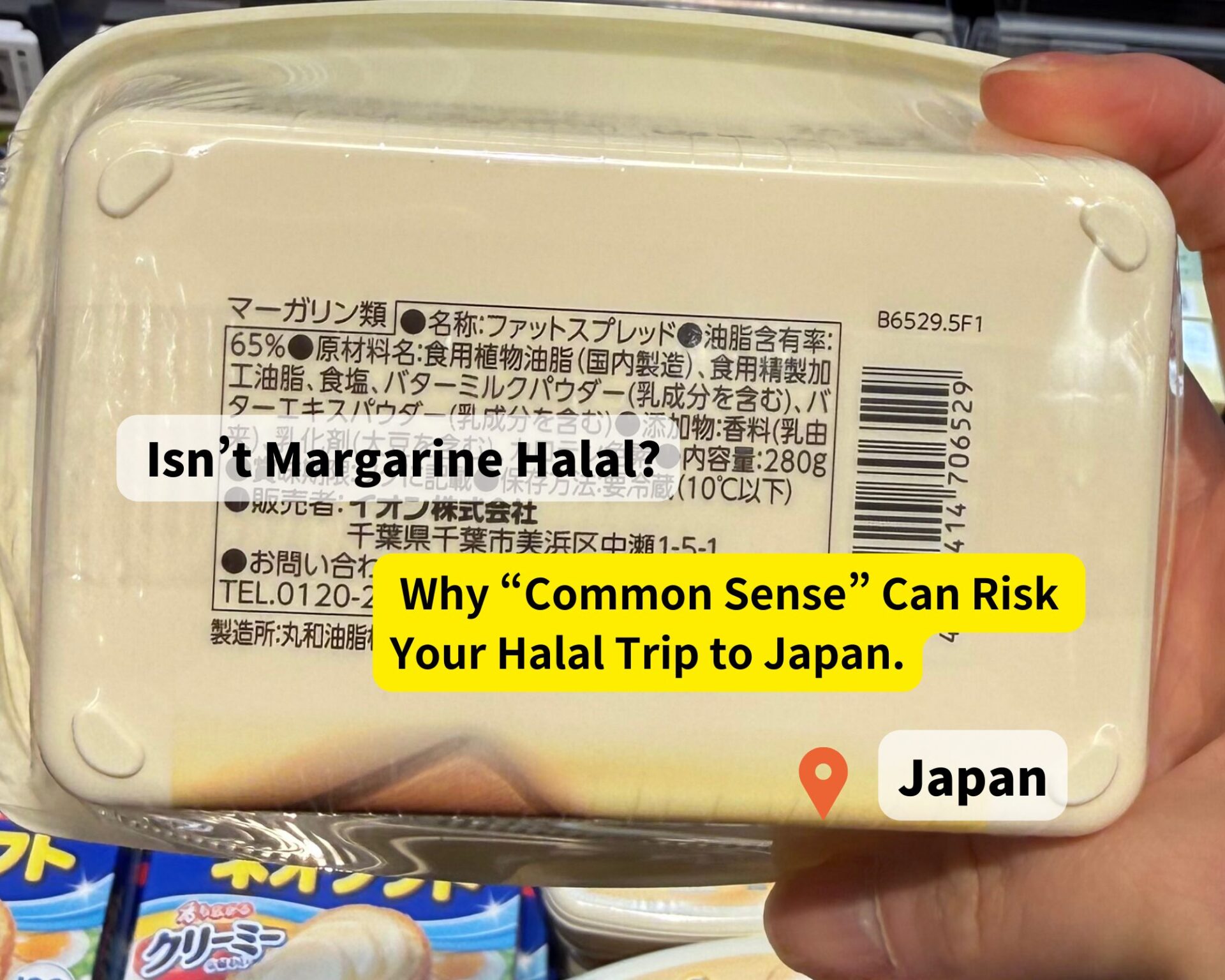

Why your “Common Sense” Can Risk Your Halal Trip to Japan
Recently, a guest told us something that truly surprised us:
“In my country, margarine is always vegetarian. It never contains animal ingredients.”
In some countries, that is common knowledge.
But in Japan, that assumption can be risky because margarine can contain animal(include pig)-derived ingredients! Let us show you why your “Common Sense” can risk your halal-compliant trip and where many Muslim travelers begin to feel uneasy.
👉Check how we ensure Muslim-Friendly Tours in Japan.
Food “Common Sense” Is Different in Japan
In many Muslim-majority countries:
- Margarine is plant-based
- Vegetarian labels are clearly defined
- Halal certification is visible
- Ingredient transparency is strong
However, Japan operates under a different food labeling system.
For example:
- Margarine may contain animal-derived emulsifiers, including pig
- Shortening in bread may be plant-based or animal-based
- Flavoring agents may be derived from animal sources
And importantly:
Under Japanese food labeling law, not all individual ingredient origins must be clearly specified.
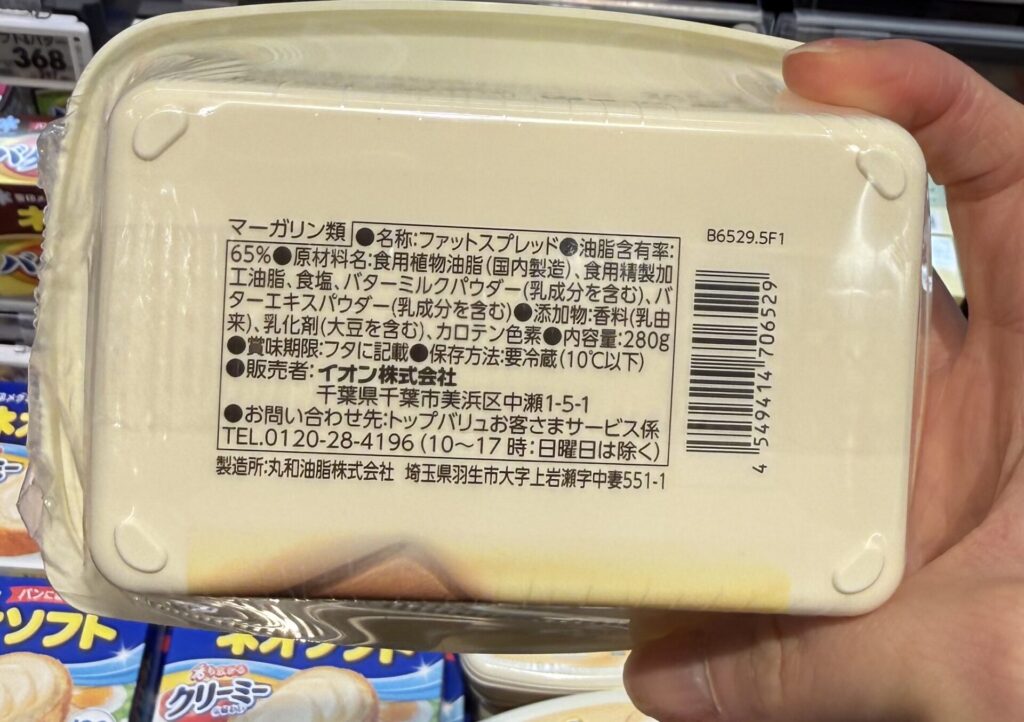
If a processed ingredient contains animal-derived components, the label does NOT always need to explicitly state “pork” or “animal origin” in an obvious way. It may be categorized under broader terms such as:
- Emulsifier
- Shortening
- Flavoring
- Processed fats
This indicate that reading a label is never enough to ensure the food is made without pig and other animal-derived ingredients.
The labeling philosophy is different in Japan.
For Muslim travelers trying to determine Halal compliance, this difference can create uncertainty.
The margarine example
In some countries, margarine = vegetable oil.
In Japan, margarine:
- Is usually plant-based
- But may include animal-derived additives
- Does not automatically indicate source origin on the front label
Without Japanese language ability or direct manufacturer confirmation, it can be difficult to determine full compliance.
This is not limited to margarine.
The same applies to:
- Bread
- Confectionery
- Instant noodles
- Sauces
- Processed snacks
Even in large cities like Tokyo and Osaka, ingredient verification often requires deeper communication.
The Real Risk: Assumption
Most Muslim travelers are careful.
They avoid obvious pork products.
They avoid alcohol.
They choose seafood.
The problem is not carelessness.
The problem is assuming that:
“Vegetarian” means alcohol-free.
“Plant-based” means fully Halal.
“Margarine” means no animal ingredients.
In Japan, those assumptions are not always reliable.
And discovering uncertainty after eating can be emotionally distressing.
Why Booking Through a Muslim-Friendly OTA Makes a Difference
This is exactly why many travelers choose structured Muslim-friendly tours instead of navigating everything alone.
When you book through our OTA:
- Restaurants are selected in advance
- Ingredient policies are confirmed in Japanese
- Alcohol-based seasonings are checked
- Cross-contamination risks are discussed
- Seafood alternatives are arranged where necessary
You do not need to interpret ingredient categories on your own.
You do not need to guess whether “emulsifier” is plant-based.
You travel with clarity.
👉Check how we ensure Muslim-Friendly Tours in Japan.
Travel With Confidence, Not Assumptions
Japan is beautiful.
Japan is safe.
Japan is welcoming.
But food “common sense” does not always translate across borders.
If you are the kind of traveler who worries:
- “Is this margarine truly plant-based?”
- “Does this bread contain animal shortening?”
- “Is this seasoning alcohol-free?”
Then you deserve more than assumption-based travel.
Our Muslim-friendly tours are designed so you can explore Japan with peace of mind — not ingredient anxiety.
Because your journey should be about discovering Japan, not decoding food labels.